


Upcoming automotive package: Crunch time for course correction

While vehicle manufacturers press on with electrification, key conditions for the transformation are not yet in place. In this op-ed, Sigrid de Vries, Director General of the European Automobile Manufacturers’ Association (ACEA), lists five major recommendations for the upcoming Commission’s Automotive Package.
As Director General of ACEA, I’m regularly asked: is the European auto industry calling to abandon electrification, and go back to the internal combustion engine? The answer is a simple “no”.
Electrification is set to lead the charge in future mobility. According to the International Energy Agency, one in four new cars in the world is electric and the share of electric cars in global sales is expected to exceed 40% in 2030. ACEA members already offer more than 300 electrified models in the EU, with many more on the way. They have invested hundreds of billions of euros. What more evidence is needed to show that the industry is delivering?
Still, I wish the task was as simple as “just” supplying electric vehicles. Reality, unfortunately, is more complicated. The European home market hasn’t recovered from pre-COVID levels; we have been missing around three million new cars per year since 2020. Global political and economic developments are putting us all to the test.
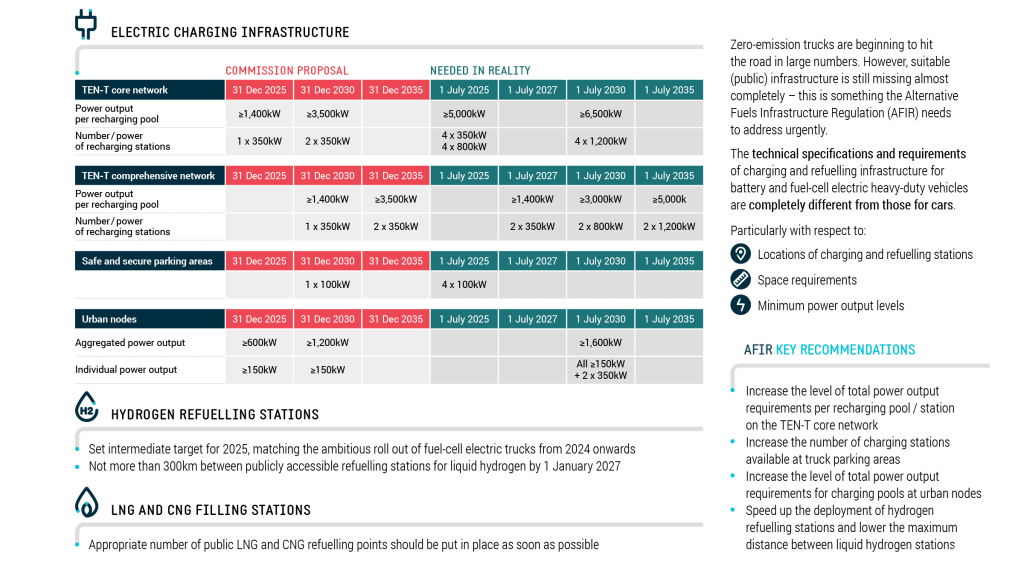
In the meantime, EU governments and regulators have not invested in, nor demanded, sufficient levels of infrastructure and grid upgrades. Adequate market incentives are often inconsistent. And mobility needs and consumer preferences remain diverse. Success requires every part of the ecosystem to be in sync, but that is not the case. The consequence: the 2030 and 2035 CO2 targets for cars and vans are no longer realistic.
Calling this out is no retreat, it is an appeal for a smarter, more pragmatic approach. For a policy framework that reflects the realities of a diverse Europe, of a multitude of mobility needs, of the importance of economic security and of global competitiveness. The European Commission’s automotive package, announced for 10 December, is a key opportunity to correct the course. Here are our five major recommendations:
1) A differentiated approach for cars, vans, and trucks
As the transition to zero-emission vehicles progresses at different speeds across segments (cars, vans, and heavy-duty vehicles), a tailored, “three-lane” approach is needed. Commercial vehicles operate under very different conditions from passenger cars, with adoption decisions driven by total cost of ownership. Vans, which are predominantly used by small and medium-sized enterprises, are essential tools that enable European businesses to operate and deliver critical services across Europe. This segment needs an even broader set of flexibilities than passenger cars and an adjustment of its CO2 reduction targets. At the same time, for trucks and buses, an accelerated review of the HDV CO2 Regulation is essential to reflect the interdependencies in the transport and logistics sector, as are short-term measures that prevent penalties caused by factors beyond manufacturers’ control.
2) A flexible and technology-open CO2-reduction frame
Today’s CO2 regulation focuses only on new vehicle supply, without doing enough to spark real demand, whether through infrastructure, total cost of ownership, or incentives, and without linking it with competitiveness and resilience. Car and van makers need flexibilities to help avoid the risk of multi-billion-euro penalties, and no drivetrain technologies (eg PHEV, range extenders, hydrogen fuel cell, etc) that can play a viable role operating on renewable energy carriers should be excluded. Any residual emissions can be compensated through other means, for example by rewarding manufacturers for CO2 reductions along the supply chain (eg use of green steel, aluminium, batteries, etc), which could give a boost to green material production. Measures like faster fleet renewal can bring emissions down as well: with 30% of all cars on EU roads older than 20 years, each new vehicle could save 6 to 12 tonnes of CO2 per car.
3) A greater focus on demand stimulus measures
Customer decisions are predominantly driven by factors such as price, taxation, electricity cost, and convenience of use. Boosting demand must therefore remain a top priority for EU and member states. In this context, corporate fleets can be encouraged to play a flywheel role. For cars and vans, priority should be given to incentives, rather than binding mandates. Fiscal incentives at national level have already proven to be a powerful tool to green fleets in many EU countries. Heavy-duty vehicles require a different recipe – here, shippers and major transport buyers should play a stronger role to drive demand by progressively increasing the share of shipments handled by zero-emission trucks. And public authorities also have a powerful toolbox: they should lead by example by prioritising zero-emission vehicles in all mobility and freight-related tenders. Lastly, charging and refilling infrastructure remains a major barrier in Europe that should be tackled: gaps between and within countries create a “three-speed Europe”, where a different pace of the infrastructure development creates large regional disparities.
4) A careful approach to “Made in Europe”
The automotive industry provides 2.5 million direct jobs. It generates over 7.5% of the EU’s GDP – if the automotive industry were a country, its turnover would be bigger than the entire Dutch economy – and it is the largest private investor in R&D in the EU. These figures speak for themselves: we are implementing an “invest in Europe” policy already every day in more than 250 factories across the EU. But the current discussion around targets or mandates for “Made in Europe” content in vehicles needs careful handling. Automotive supply chains are global and incredibly complex; any local content requirements must be phased in gradually, with enough lead time and differentiation across segments. They should rely on smart incentives and be designed to respect trade partners and rules. And let’s not forget the fundamentals of competitiveness: affordable energy, faster permitting, skilled workers, funding to build and run battery manufacturing. Local manufacturing will continue to flourish only if Europe remains an attractive place to invest.
5) A bolder approach to regulatory simplification in the automotive sector
Supported by dedicated industrial policy tools and synchronised with key demand-side stimulus, the European automotive industry can regain a leading position in competitive and profitable vehicle manufacturing across all segments in Europe. In general, the Automotive Omnibus is a welcome step towards simplification. But more work will need to be done given the more than one hundred upcoming legislative acts lined up for the next five years, each affecting design, manufacturing, and investments in the automotive industry. We fully support the push, announced by Commission President von der Leyen, to revive the manufacturing of small, affordable vehicles in Europe, where the impact of simplifying regulation could be greatest. A more staggered implementation of legislation could be another solution. Truck manufacturers, for example, ask to postpone implementation of some parts of the Euro 7 legislation. In an industry with long development cycles, legislative timelines must reflect industrial and market realities.
For me, there is no question that the stakes are high. Europe’s automotive sector is a cornerstone of the continent’s economy. Many regions depend on the automotive ecosystem for employment and revenue. Working in the sector has long been a source of pride, and automotive mobility remains a key source of freedom and prosperity. But leadership cannot live on political ambition alone. To give us a fighting chance, a course correction is urgently needed in the policy framework. The Commission’s upcoming package is an important moment of truth.
Europe’s automotive sector is a cornerstone of the continent’s economy. Many regions depend on the automotive ecosystem for employment and revenue. Working in the sector has long been a source of pride, and automotive mobility remains a key source of freedom and prosperity. But leadership cannot live on political ambition alone. To give us a fighting chance, a course correction is urgently needed in the policy framework. The Commission’s upcoming package is an important moment of truth.